Recarburisers for Foundries and Steelworks
EXOTERM supplies recarburisers under the KARBURIT brand for increasing the carbon content of molten iron and steel.
Recarburisers are carbon-rich metallurgical additives that dissolve in the molten metal and are used to adjust the final carbon content of iron alloys and steel. Different applications require different carbon levels, sulphur contents and particle sizes, which is why KARBURIT is available in several qualities and granulometries.
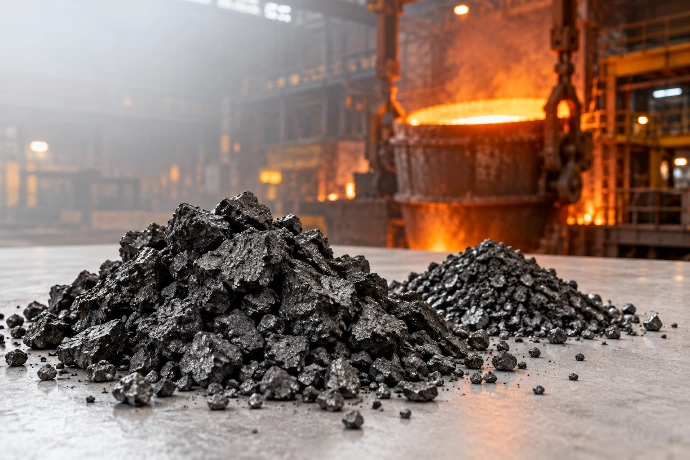
What is a recarburiser?
A recarburiser, also known as a carbon raiser, carburiser or carbon additive, is added to molten metal to increase or correct its carbon content.
It is commonly used during melting and metallurgical treatment where the initial charge does not provide sufficient carbon or where precise adjustment of the melt composition is required.
EXOTERM KARBURIT recarburisers are available for applications in:
cast iron production,
iron alloys,
steelmaking,
adjustment of carbon content during melt preparation.
How do recarburisers work?
The recarburiser is added to the molten metal, where the carbon-containing material gradually dissolves into the melt.
The appropriate product depends on several parameters, including:
required carbon content,
permitted sulphur level,
melting process,
type of alloy,
required particle size,
addition method,
process conditions.
Correct product selection helps achieve controlled carbon adjustment and stable melt composition.
KARBURIT recarburisers
EXOTERM offers several KARBURIT grades with different chemical compositions.
| Product | Carbon | Sulphur | Moisture | Ash | Volatile Matter |
|---|---|---|---|---|---|
| KARBURIT NL | min. 99% | max. 0.06% | max. 0.50% | max. 0.5% | max. 0.5% |
| KARBURIT PK | min. 98% | 1.2–1.3% | max. 0.50% | max. 0.5% | max. 0.5% |
| KARBURIT NG | min. 95% | max. 0.2% | max. 0.50% | 3–4% | max. 1.0% |
| KARBURIT B-H | min. 97% | max. 0.10% | max. 0.50% | 2–3% | max. 0.5% |
| KARBURIT MIX | Upon request | Upon request | Upon request | Upon request | Upon request |
Need Assistance?
Frequently Asked Questions
Here are answers to common queries about recarburisers and our offerings.
A recarburiser is used to increase or adjust the carbon content of molten iron or steel during the melting or metallurgical treatment process.
The choice of recarburiser should not be based on carbon content alone.
The following parameters should be considered:
Carbon content
A higher fixed carbon content allows more carbon to be introduced with a smaller quantity of material.
Sulphur content
The permitted sulphur level depends on the alloy and metallurgical process. Applications requiring low sulphur levels therefore require an appropriate KARBURIT quality.
Ash and volatile matter
Ash and volatile matter differ between recarburiser qualities and should be considered when selecting the material for a particular melting process.
Particle size
Granulation affects handling and the way the material is introduced into the melt. EXOTERM therefore supplies KARBURIT in different particle-size ranges according to the application.
The optimum grade depends on the alloy, melting technology and required final chemical composition.
As a general selection procedure, we recommend providing the following information:
type of iron or steel,
melting furnace or process,
required carbon increase,
maximum acceptable sulphur content,
current recarburiser or charge materials,
required granulation,
typical batch or melt size.
Based on these process parameters, EXOTERM can recommend a suitable KARBURIT grade and granulation for industrial testing.
Yes. KARBURIT MIX can be prepared according to agreed requirements regarding composition and other relevant parameters.
In foundry and metallurgical terminology, the terms recarburiser, carburiser, carbon raiser and carbon additive are often used for materials whose purpose is to introduce additional carbon into molten metal.
The main parameters include carbon content, sulphur content, ash, volatile matter, moisture, particle size and the requirements of the specific melting process.
Yes. Different KARBURIT grades have different sulphur levels. For example, KARBURIT NL has a specified sulphur content of maximum 0.06%.
Need help selecting a recarburiser?
Send us information about your alloy, melting process, required carbon adjustment and sulphur limitations.
Our technical team can help you select the appropriate KARBURIT quality and granulation for your application.